The Art of the Fit
A beautiful frame is not enough. Here is what truly makes eyewear work and why the most technically perfect pair you will ever wear might be one you would never choose at first glance.
There is a moment every eyewear designer knows well. A customer picks up a frame, tries it on, and their face simply lights up. The proportions are right. The bridge sits flush. The temples follow the skull without pressure. Everything aligns and the frame disappears, as good design always should.
Then comes the other moment. A frame that is undeniably beautiful, hand-polished acetate, precise rivets, a silhouette refined over months of iteration, sits on a face and looks entirely wrong. Not ugly. Just off. The customer hands it back and says, apologetically, "It's not quite right."
They are right, of course. But the reason is rarely aesthetic. It is anatomical. And understanding that distinction is where design ends and craft truly begins.
Where Everything Begins
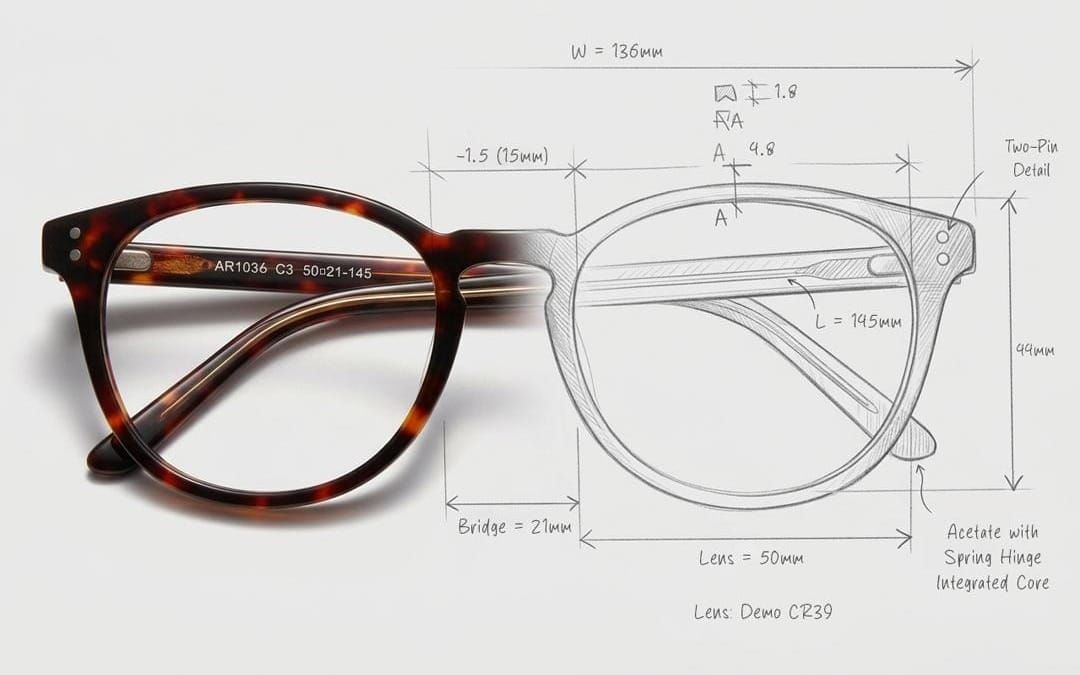
The bridge is the most consequential millimetre in eyewear. It is the only point of structural load-bearing contact between the frame and the face, and yet it is the measurement most casually treated in mass-market design. Bridge width, the gap between the two lenses, must correspond almost exactly to the width of the wearer's nose at the point where the glasses should sit, typically between 14 and 24 mm in adults.
A bridge that is too narrow pinches inward, leaving indentations on the sides of the nose and causing the glasses to sit higher on the face. A bridge that is too wide causes the frame to slip downward, forcing the wearer to constantly push their glasses back up.
Beyond width, the bridge geometry. Its height, its depth, its pad angle must account for the nose's topography. Adjustable nose pads offer precision but introduce their own aesthetic trade-offs that not every design can absorb gracefully.
The Long Reach of Discomfort
Temples, the arms that extend from the frame front to the ear, are measured from the hinge to the bend, and that bend must land precisely at the ear. Too short, and the constant pressure behind the ear becomes unbearable. Too long, and the frame slips forward, carrying with it the lens, distorting vision and necessitating the glasses be pushed back into position continually.
Standard temple lengths run from 135 to 155 mm, with most adult faces falling between 140 and 148 mm. The variation sounds small. It does not feel small after a full day of wear. Attentive opticians will adjust the bend point individually for each customer — a process that takes less than two minutes but that can transform a tolerable frame into one that genuinely vanishes from awareness.
The Curve That Follows the Face
Base curve, the front surface curvature of a lens, is expressed as a number from 0 (flat) to 12 (deeply curved). Most standard ophthalmic lenses sit between base 4 and base 8. The frame's front must match this curvature to prevent the lens from buckling or creating optical aberration at the periphery.
But beyond optics, lens curvature also defines how the frame wraps around the face, and this is where aesthetics and anatomy intersect most visibly. A flatter lens (base 4) sits farther from the face, creating a more formal, vintage appearance. A higher base curve (6–8) wraps closer to the orbital bone, offering more peripheral coverage, better protection from wind and debris, and a more athletic silhouette.
The critical constraint is the relationship between base curve and the face's own curvature. Prominent brow bones and deeper orbital sockets accommodate a more dramatic wrap naturally. Flatter facial profiles require a shallower curve to prevent the lens from touching the cheek with every smile.
Why Three Points Make Everything
A frame contacts the face at exactly three points. The bridge and the two temple tips. This is not a compromise, it is an elegantly minimal system. Three points define a plane. Any fewer and the frame rocks. Any more and you introduce competing pressure points that cannot all be satisfied simultaneously.
The fitting challenge is that these three contact points must be calibrated together, not in isolation. A perfect bridge fit means nothing if the temples are too tight and tilt the frame upward, shifting the bridge off-centre. A beautifully adjusted temple pressure is wasted if the bridge is too wide and allows the front to droop. The frame is a single mechanical system, and its three contact points must be understood as one.
This is why remote or online frame fitting, however sophisticated the algorithms, remains genuinely difficult. A 3D face scan can estimate pupillary distance and approximate bridge width. It cannot replicate the experienced hand of an optician who adjusts frame bend by feel, who watches the customer's brow relax as pressure resolves, who knows that a 1-mm adjustment to the left temple changes everything.
Beautiful Frames Built to Fit No One
Here is the uncomfortable truth that every serious eyewear designer eventually confronts. The most photogenic frame is often the least wearable one. The sweeping cat-eye that photographs magnificently may have a bridge angle that works on fewer than 15% of faces. The perfectly round lens that looks exquisite in still life may have a base curve that sits too far away from the cheek on most wearers.
Fashion eyewear lives in this tension deliberately, and that is a valid artistic choice. Editorial frames are not required to be comfortable. They are required to be remarkable. But optical eyewear, eyewear that a person will wear for twelve hours a day every day for two years, must answer to a different standard.
The designers who navigate this tension most successfully are those who begin with the fit requirements and discover the aesthetic within those constraints. Rather than beginning with the aesthetic and hoping fit follows.
The most enduring frames, the ones customers refuse to replace and describe with genuine affection, are rarely the ones that looked best on the shelf. They are the ones that disappeared. That ceased to be objects and became, simply, the way the world looked. That is the art of the fit. To design something so precisely right that it stops being noticed at all.