Sourcing: The Problem Nobody Talks About
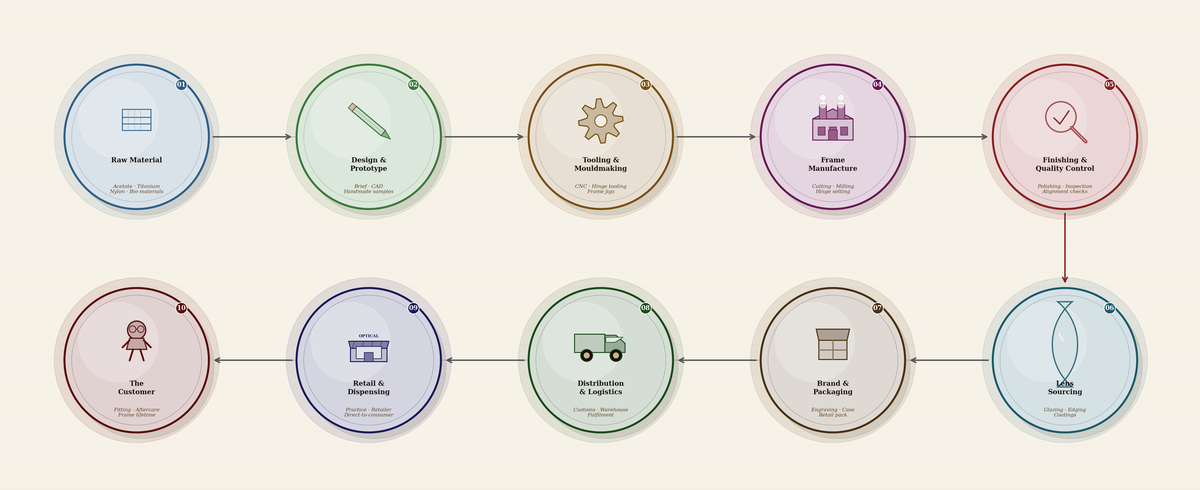
Everyone in eyewear talks about design. About materials, about brand identity, about the customer experience. Far fewer talk honestly about where the product actually comes from, and why getting that part right is harder, more expensive, and more consequential than almost anything else a brand does.
Ask a new brand founder where their frames are made and they will usually tell you, with some pride, which country the factory is in. Ask them who specifically makes the frames, under what terms, with what quality controls, and with what contingency if something goes wrong, and the conversation changes quickly.
Sourcing eyewear is not complicated in the way that brain surgery is complicated. It is complicated in the way that trust is complicated. It requires judgment developed over time, relationships built across language barriers and time zones, and a tolerance for discovering, often at the worst possible moment, that something you assumed was understood was not understood at all.
After 25 years in this industry, I have seen sourcing decisions make brands and quietly destroy them. Here is what I wish more people understood before they signed their first production agreement.
Where Eyewear Is Actually Made
The global eyewear supply chain is more concentrated than most people outside the industry realise. The overwhelming majority of the world’s eyewear (across every price point and every brand category) is manufactured in one of three places: China, Italy, or Japan. Each carries a different set of implications, and choosing between them is not simply a matter of budget.
China dominates on volume. The Wenzhou, Shenzhen and Xiamen regions between them produce an extraordinary proportion of the world’s eyewear. The range of quality available from Chinese manufacturing is enormous: from the cheapest commodity product imaginable to work that would stand comparison with anything made in Europe. The challenge is knowing the difference, and knowing which factories can consistently deliver at which level.
Italy carries a quality signal that the market still responds to powerfully, particularly in the premium and luxury segments. The Cadore region has been producing eyewear for over a century, and that accumulated knowledge is real. Italian manufacture typically means higher setup costs and longer lead times. What it usually delivers in return is craftsmanship, consistency, and a provenance story that a certain customer segment actively values.
Japan occupies a different space again. Japanese manufacturing (particularly out of the Sabae region in Fukui prefecture) is associated with extraordinary precision and finishing quality. It is also the most inaccessible for new entrants. Factory relationships in Japan are typically built over years, introductions matter enormously, and the expectation of commitment on both sides is high. You do not simply place an order with a Sabae factory. You begin a relationship.
The MOQ Conversation Nobody Enjoys
Minimum order quantities are where the theory of sourcing meets the reality of cash flow, and it is where many independent brands first encounter the fundamental tension of building a product business.
A factory running acetate production has tooling to amortise, materials to batch, and a production schedule to optimise. When they quote you a minimum number of units per style per colour, they are not being unreasonable. They are describing the economic floor below which the production run costs them money rather than making it. Understanding this (genuinely understanding it, not just grudgingly accepting it) changes how you negotiate.
MOQ varies depending on the type of factory you are working with and the material the eyewear is made from. External pressure on raw materials or component parts can dictate the MOQ.
There is also the question of what happens to your excess stock when you have ordered 300 units and sold 180. This is not a hypothetical. It is the standard experience of an early-stage eyewear brand finding its market. Building that reality into your financial model before you place the order, rather than after, is the difference between a manageable inventory position and a serious problem.
The Specification Gap
The single most common cause of sourcing failure I have witnessed is specification ambiguity. The brand believes they have communicated clearly. The factory believes they have understood. The sample arrives and neither party can quite explain how it ended up looking like this.
Eyewear specifications are genuinely complex documents. A complete technical brief for a frame will typically run to several pages and cover: exact dimensions for every measurement point, hinge type, hinge placement, temple profile, end piece geometry, bridge style and dimensions, nose pad specification, lens shape, lens size, base curve, material specification including colour reference and pattern orientation, surface finish, logo placement and method, and packaging. Miss any one of these, or express any of them ambiguously, and you will receive something other than what you intended.
The brands that source most successfully tend to be those that invest heavily in the technical brief. The first sample should not be the moment you discover that your bridge specification was unclear. It should be the moment you confirm that your brief was understood exactly as written.
This is also why experienced sourcing relationships are so valuable. A factory you have worked with across multiple collections begins to know your standards, your tolerances, and the decisions you would make if asked. That institutional knowledge does not exist with a new supplier, and it cannot be substituted with a longer brief. It has to be built.
Quality Control: Who Is Watching?
Every factory will tell you they have quality control. And they do. The question is whose quality standards are being applied, and who is doing the checking.
For brands working with factories at distance (which is most brands working with Asia) the choice is essentially between trusting the factory’s own QC, engaging a third-party inspection service, or building enough factory visits into the production calendar to have direct visibility. Each has costs and limitations.
Third-party inspection (having an independent QC agent examine a production run before it ships) is standard practice for brands of a certain scale and is genuinely valuable. The inspector works to an AQL (Acceptable Quality Level) standard, sampling a statistically meaningful proportion of the run and measuring against a pre-agreed specification. What it cannot do is catch the problems that only become apparent after six months of wear: a hinge that works perfectly when new but develops play under regular use, an acetate that was not properly annealed and begins to warp in heat. Some issues only reveal themselves over time.
Factory visits change the dynamic significantly. There is something that happens when a brand representative is physically present on the production floor that does not happen when the relationship is conducted entirely through email and samples. Standards are different when someone is watching. Problems surface earlier. Conversations that might otherwise be avoided happen naturally.
The Relationship Is the Supply Chain
The optical industry runs on relationships in a way that surprises people coming from other consumer goods sectors. Factories that produce exceptional work at fair prices with reliable delivery do not need to advertise. Their capacity is typically committed to existing partners. Getting access to them means knowing someone who can make an introduction, or building a reputation over time that makes you a brand they want to work with.
This is particularly true at the upper end of the quality spectrum. The best premium manufacturers are not looking for new customers. They are looking for the right new customers: brands with clear creative direction, realistic expectations, and the kind of stability that makes a long partnership viable. Arriving at a meeting at Mido with a half-formed brief and an unrealistic budget will not open those doors. Arriving with a clear collection, a production history, and a genuine understanding of what you are asking for might.
In addition to this, factories make choices about how they work with customers. A brand that is difficult, that changes specifications mid-production, that pays slowly, that makes demands outside the agreed terms: will find their allocation quietly deprioritised when the factory’s capacity is under pressure. The best factory relationship is one where both parties believe they are getting a good deal. Achieving that requires understanding what the factory actually values, which is not always what you assume.
What Good Sourcing Actually Looks Like
After all of this, what does sourcing eyewear well actually look like in practice?
It looks clear relationships, with factories you have taken the time to understand. It looks like technical briefs that leave nothing ambiguous, and sample rounds that are treated as a serious process rather than a formality. It looks like visiting the factory before you need something from them, not only when something has gone wrong.
It looks like honest unit economics that include the cost of the samples that did not work, the inspections, the excess inventory, and the time that all of this takes. And it looks like a sourcing strategy built around relationships: because in this industry, the relationship is not a soft benefit on top of the commercial arrangement. It is the commercial arrangement.
The brands that get sourcing right tend to be quiet about it. There is no marketing advantage in announcing that your production calendar is reliable or that your factory partner flags problems before they become shipment issues. But inside the business, that stability is everything. It is what allows the creative work to happen. It is what allows the brand to grow without constantly fighting fires that should never have started.